From this bishop’s homily for his father’s funeral mass....”Because, you see, the reception of the Eucharist, that intimate connection with Jesus, was at the very center of his relationship with God.”
Eucharist at center of my father’s faith life - Arkansas Catholic - October 3, 2019: Eucharist at center of my father’s faith life - Arkansas Catholic - October 3, 2019
Saturday, October 19, 2019
Wednesday, October 16, 2019
Things I should have learned in Catholic school (but didn't)
These are in no particular order. I'm just listing them as they come to mind.
1. The sacredness of the Holy Mass and the scriptural basis for Transubstantiation. Basically, we should have attended daily Mass in school as was the practice when my father's generation was in Catholic school. By the time I started Catholic school in the early 70's, we attended Mass once a week. I'm not complaining. Weekly Mass was wonderful. I'm grateful that I was able to attend weekly Mass with my fellow students. It was important to me then and is even more so now. Catholic schooling impressed that on my heart. But we should have attended daily Mass. The Mass and the Eucharist in the Mass is the sole source and summit of the Catholic faith. By the time I got to high school, Mass was optional. We had all-school masses a handful of times in the school year. The rest of the time we were allowed the option of attending Mass if we had an open mod (open study hall) during Mass time, which I think was around 11 a.m. Most teenage girls are not going to choose to go to Mass when they can go to open study halls to laugh and talk with their friends for an hour. In high school, Mass attendance was relegated to the backburner of our Catholic education in favor of a more scholastically-oriented curriculum. Catholic schools have to keep competitive. Their enrollment depends on the educational success of their students/alumni. We were pushed to score well on standardized testing and get accepted to good universities. Mass was at the bottom rung of our Catholic high school education.
2. The Magisterium - The teaching arm of the Catholic Church. The Magisterium of the Roman Catholic Church is the church's authority or office to give authentic interpretation of the Word of God, "whether in its written form or in the form of Tradition." I never even heard the word "Magisterium" until 2002. To learn more about the Magisterium of the Catholic Church, see http://rediscover.archspm.org/belonging/what-is-the-magisterium-and-why-does-it-matter/
3. Receiving the graces obtained by the sacrament of confession and reception of the Eucharist. Most of all, how it is a non-negotiable that we must be in a state of grace when we receive the Eucharist. Specifically, I was never taught that I must be free of mortal sin and in a state of grace in order to receive the Eucharist. The reception of the Eucharist absolves us of venial sin, but for mortal sins, we must be absolved by confession (barring extreme circumstance where no confession with a priest is possible.). Scriptural basis for this is in 1 Corinthians 11:27. "Therefore whoever eats the bread or drinks the cup of the Lord in an unworthy manner, shall be guilty of the body and the blood of the Lord. 28 But a man must examine himself, and in so doing he is to eat of the bread and drink of the cup. 29 For he who eats and drinks, eats and drinks judgment to himself if he does not judge the body rightly. 30 For this reason many among you are weak and sick, and a number sleep."
3. The Early Church Fathers. This topic was never addressed in any of the religion or history classes in which I studied in Catholic school. Just as I learned in Evangelical Protestantism, Jesus' earthly life ended at the end of the bible, and then we fast forwarded to the Reformation and Martin Luther, and then skipped to the present day. Nobody ever told me that there exists an entire body of work written by the first Century Christians, especially those who learned at the feet of the apostles (Peter, Paul, other apostles all had disciples of their own whom they taught. Those disciples wrote down what they learned, the first-hand witnesses of Jesus). I wonder if any of my religion or history teachers knew about the early church fathers. These early Christians established the First Century Church as instructed by Jesus himself.
4. The full deposit of faith. Our Church possesses the true, authentic deposit of faith. Catholicism is based on the inerrant word of God in scripture, sacred tradition, and faith. Scriptures that bear this out:
- “There are also many other things which Jesus did; were every one of them to be written, I suppose that the world itself could not contain the books that would be written” (John 21:25).
- “Follow the pattern of the sound words that you have heard from me, in the faith and love which are in Christ Jesus; guard the truth that has been entrusted to you by the Holy Spirit who dwells within us” (2 Tim. 1:13–14). Then he elaborates further, “And what you have heard from me before many witnesses entrust to faithful men who will be able to teach others also” (2 Tim. 2:2). Paul describes in Sacred Scripture exactly how Sacred Tradition is passed on: by hearing, in another word, orally.
- At another time, Paul writes that Sacred Tradition may be handed on orally or by writing. “To this he called you through our Gospel, so that you may obtain the glory of our Lord Jesus Christ. So then, brethren, stand firm and hold to the traditions which you were taught by us, either by word of mouth or by letter” (2 Thess. 2:14–15).
6. Traditional Catholic prayers. We learned the basic three. Our Father, Hail Mary, Apostle's Creed. Maybe the Angelus or the Hail Holy Queen were thrown in. But we have a whole huge library of prayers that we should know.
7. The Bible is a Catholic Book and we should know it like the back of our hand. The Old Testament Canon was decided upon at the Council of Trent (1545-63). The two other councils that decided the rest of the scriptural canon were the Councils of Carthage and Nicea. The canon of scripture was decided upon before the reformation. The bible is a CATHOLIC book. Martin Luther didn't like some things about it and he removed what he didn't agree with. He removed seven books of the original scriptural canon. However, even Martin Luther acknowledged that the Bible is a Catholic book. He said “We are obligedto yield many things to the Papists--that with them is the Word of God, which we received from them; otherwise we should have known nothing at all about it."
**NOTE: I give my Catholic High School religion teachers kudos for this item. My Catholic High School religion studies required a lot of scripture reading. We had to own a bible and bring it with us to school. Our religion homework included a fair amount of, not just the words of scripture itself, but we even had to read the italic sections that explained the background story of the different books of the bible. When I had married and moved away from my parents' home, I left behind my high school bible. In the subsequent years, my mother would flip through that Good News Bible, and later on, she commented to me that she flipped through that bible and was surprised to see how well-worn my old bible was. It was filled with my handwritten notes and highlighted texts. Because of the religion teachers at Providence, I gave that bible a workout, and my mother could tell from the shape it was in. THANK YOU TO THE SISTERS AND LAY TEACHERS AT PROVIDENCE CATHOLIC SCHOOL FOR MAKING ME USE MY BIBLE. However, (yes, there is a however) I should have been taught how to defend my faith with the use of scripture. When Evangelicals came at me with scripture in later years, I never knew how to answer. I do now, but I'm working to improve.
8. The scriptural roots of Marian dogma and the saints.
This is all for now. I will add more items to this list in the future.
- Rosie, 10/14/2019 (attended Our Lady of the Pillar Catholic Kindergarten, Holy Rosary and St. Paul's Catholic Schools, and Providence High School '83)
Monday, October 14, 2019
I highly recommend this book. At the beginning of the new Millenium, I discovered a whole new world of Catholic teaching and wonderful books written by the new breed of Catholics - former Protestant clergy who became Catholic converts. My experience of 15 years worshipping in the Assembly of God churches had led me to believe that unhappy Catholics seeking a deeper relationship with Jesus routinely LEFT THE CATHOLIC CHURCH in order to be fulfilled spiritually. I remember Wednesday evening church services at the AoG churches where it was a lighter service, more open to fellowship, sharing, and "witnessing." Much of what was shared and witnessed was from former Catholics who passionately shared their disappointment in Catholicism and how they had "left the Catholic church and became real Christians." I personally had never, ever met a Protestant-turned-Catholic convert in my Catholic life. I assumed it just didn't happen. Pastor Jim Batts, at our church, Pentecostal Holiness Church in Jacksonville, Florida, used to love to point out my hubby and me during church services. "Mike and Rose used to be Catholic, but the Lord delivered them from all that and they're real Christians now...."
Fast forward to the fall of 2000 when I decided to return to full communion with the Catholic Church. I wasn't excited about it, but it was something familiar and, from my experience, didn't require much from me personally. In a sense, I saw it as a lazy Christianity and I was fine with that. I made some promises to myself. I would never pray to or worship Mary (that meant no rosaries) and I would make sure that anything I did as a Catholic was based in scripture. I solidified my decision by preparing my daughter for her first communion at home (with my parish's consent). She was already 9 years old and, if we were going to be Catholic again, she was overdue for her first communion. We did that.
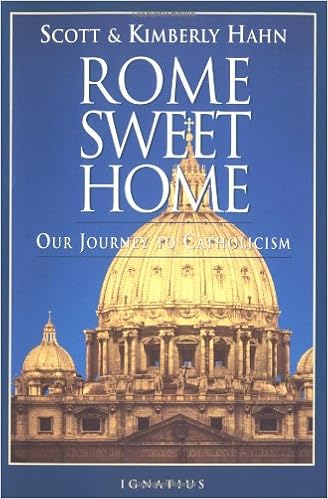
During early 2000, I started googling (that was new for the time) Catholicism. The search results that were appearing on my computer screen were not what I expected. The first one I found was catholicity.com. This site proved to be the doorway to a whole new world of faith and hope and charity, and was to become my source for my Catholic reversion studies. Catholicity.com led me to discover the world of modern Catholic Apologetics. I discovered the books of Scott and Kimberly Hahn, Jeff Cavins, Tim Staples, Jimmy Akin, and to the stories of these very people, most of whom were not born or raised Catholic but instead had discovered Catholicism as Protestant clergy converts. This was seriously big news to me. I didn't think Protestants became Catholic. I had only known it the other way around. I had met more ex-Catholic Evangelicals than I could count. I read all the books I could find, Rome Sweet Home, My Life on the Rock, Crossing the Tiber. I wanted to know what it was that these former Protestants had discovered in the Catholic Church that I had obviously missed out on despite 13 years of Catholic schooling. God opened up a world of knowledge that consisted of learning and reading the teachings of the Early Church Fathers (apostolic, ante-Nicene, etc.), Catholic apologetics (my father had thought this meant that Catholics were apologizing for the Inquisition, and I was able to tell him that Apologia means to defend). These apologists were the newest generation of Catholic defenders.
This particular book, Rome Sweet Home, was the first book that I read after deciding to return to Catholicism. It was a life and heart changer. I highly recommend it. I learned more about my faith and church history from books written by former Protestants than I had learned in all my years in Catholic school. (I won't tell my mom that, poor thing. She and my dad had sacrificed a lot to put me and my siblings through Catholic schools).
If you haven't read Rome Sweet Home, I highly recommend that you do. Your faith will never be the same.
Have a beautiful, blessed day!
Tuesday, October 1, 2019
The uphill climb of daily Mass
It is a challenge to live a life of daily Mass attendance. At a very difficult time in my professional life, I woke up at 4:30 a.m. to attend the early Communion service at St. Brigid's Catholic Church. I was facing some real challenges at work and some of the people that I had to work with were not very nice, to say the least. I felt I needed the extra spiritual strength that I knew I would receive from receiving the Eucharist daily. The job went from bad to worse (hostile place), and eventually, I resigned. I would probably have resigned much sooner if I had not had the extra inspiration and graces received from daily reception of Christ in the Eucharist.
Fast forward to now, I have felt a real need to start attending daily Mass. Many years ago, there were many local parishes that had super early morning Mass, at 6 a.m. Now, those Masses are harder to find, but there are a few in San Antonio. St. Brigid still has their 6 a.m. Communion service. It is not a full Mass. It is Liturgy of the Word followed by Communion. If I remember correctly, the service is led by a Deacon of the parish.
St. Matthew's Catholic Church on Wurzbach Road has the most daily Masses of all the local Catholic Churches. I reviewed the listings at masstimes.org and at the Archdiocese parish search page. Many of the local parishes have only one Mass per day. St. Matthew's has a 6 a.m. full Mass, Monday through Friday, at 6 a.m., 8:15 a.m., 12:05 p.m., and 6 p.m. On Saturdays they have 8:15 a.m. Mass in addition to Saturday Vigil Mass at 5:30 p.m. What a blessing for those who want to practice daily reception of Christ in the Eucharist!
My problem is a common one. The spirit is willing, but the flesh is weak. The 6 a.m. is the only Mass that really fits my schedule during the workweek. This means that to make daily 6 a.m. Mass I need to be up by at least 5 a.m. (and have everything laid out the night before to be dressed and out the door on time. I didn't make it that far today. I'm going to try again tomorrow. I know firsthand the incredible graces that are manifest in the life of a daily communicant. I want to live that life. Here's to tomorrow!
https://stmatts.org/mass
Subscribe to:
Posts (Atom)